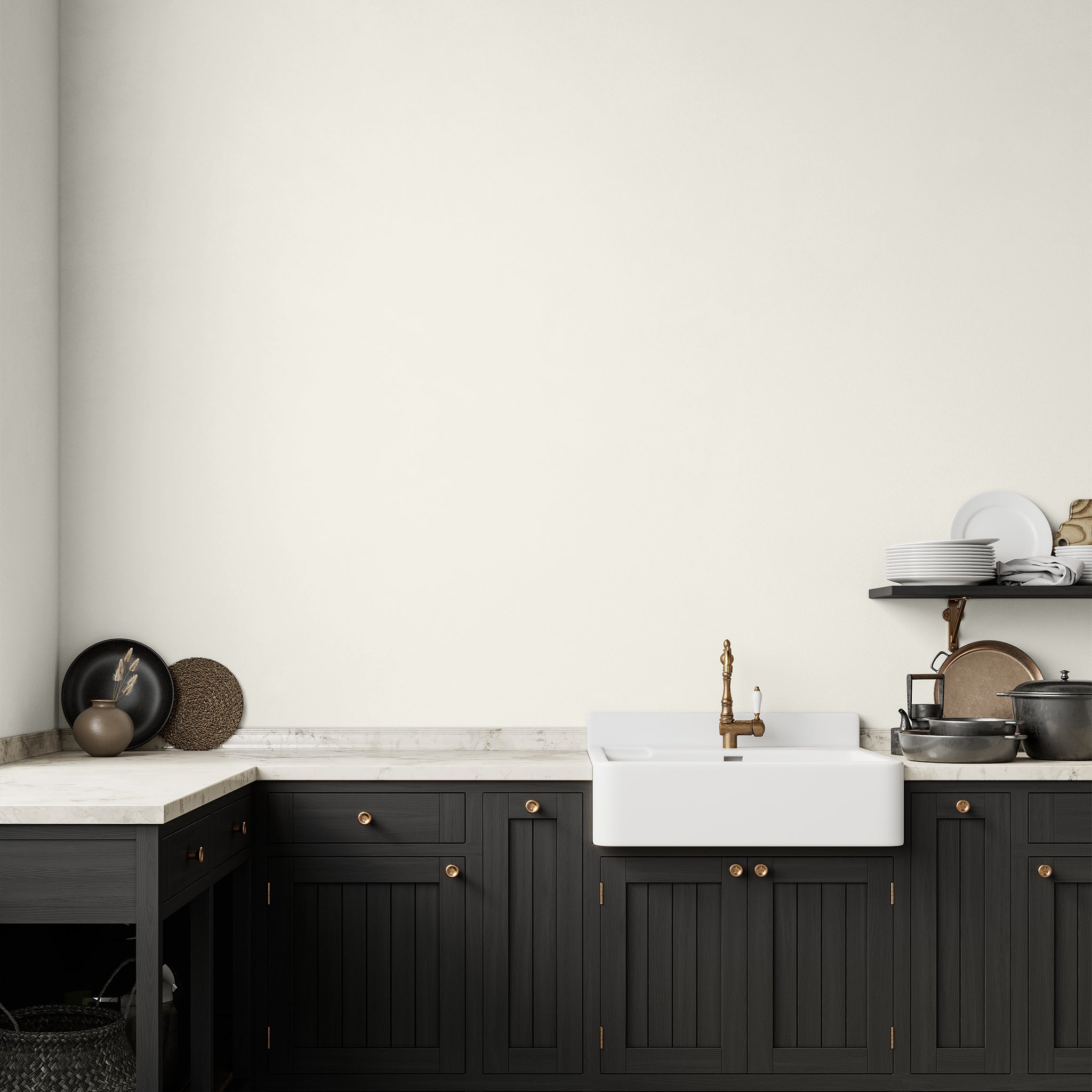
The kitchen is the hardest-working room in the house, and the paint in it has to keep up. Grease in the air, steam off the cooktop, splashes behind the bin, fingerprints around the light switch. A finish that looks beautiful in the living room can struggle here within a year.
So the question is not only which colour. It is which finish, on which surface, and how to choose a colour that still looks right next to your benchtop at 7am.
Here is the short version, and it is not the one most of the internet gives you.
The short answer
In an Australian kitchen, the finishes split by surface:
- Walls: interior low sheen. Soft, calm, and forgiving, and washable enough for everyday marks.
- Trim, doors, window frames and cabinetry: semi gloss. Harder and wipeable, made for the surfaces that get touched, knocked, and scrubbed.
- The splash zone behind the cooktop and sink: your splashback. Tile, glass, or stone does the heavy lifting, which is exactly why your walls do not need a high-gloss finish.
Most guides tell you to paint kitchen walls in semi gloss. That is an American habit, and it is not how good Australian kitchens are finished. Semi gloss belongs on the trim. Here is why.
Why kitchen walls need the right finish (not a glossy one)
Every other room asks your walls to look good. The kitchen asks them to look good and survive. Three things make it tougher than anywhere else:
- Grease and steam settle as a fine film, even a metre from the stove
- Marks happen daily, and they need to come off without taking the colour with them
- It is high-traffic, so surfaces get touched, brushed past, and cleaned far more often
It is tempting to answer all of that with the hardest, shiniest paint you can find. But a high-gloss wall creates its own problems, and a kitchen already has plenty of help dealing with mess.
The best finish for kitchen walls: low sheen
Low sheen is the right finish for kitchen walls, the same as the rest of your home.
It has a soft, near-matte surface with just enough durability to wipe down. In a kitchen, that matters more than you would think:
- It hides imperfections. Kitchen walls are busy with power points, joins, and cabinetry returns. Low sheen absorbs light and keeps them quiet. Semi gloss does the opposite: every bump, roller mark, and patch repair shows up under the reflection.
- It is washable enough. A quality interior low sheen takes a damp cloth to the everyday marks that land on a wall. The real grease zone is handled by the splashback, not the wall.
- It suits a kitchen full of hard surfaces. Stone benchtops, glass splashbacks, stainless steel, and tile already bounce a lot of light. Low sheen walls calm all of that down instead of adding more glare.
Our interior low sheen is made for exactly this. It is the finish we would put on your kitchen walls without hesitation, and on the walls right through the rest of the house.
If you want the full breakdown of how the two finishes behave, we wrote a separate guide on low sheen versus semi gloss. The short version for walls is: low sheen almost every time.
Where semi gloss belongs: trim, doors and cabinetry
Semi gloss is not a wall finish. It is a trim finish, and it is the right one.
It has more resin and a harder, slightly reflective surface that wipes clean and takes a knock. That makes it perfect for the surfaces a kitchen actually punishes:
- Skirtings, architraves, and door frames
- Doors and window sills
- Cabinetry and joinery, where hands, sponges, and bag corners land every day
This is the part most people get backwards. The wipeability you want in a kitchen lives on the trim and the cabinets, not on the broad walls. Put semi gloss where it earns its keep, and your kitchen looks considered rather than shiny.
Our colours come in semi gloss for exactly these surfaces, in the same palette as the low sheen, so your walls and trim can share a colour or play off one another.
What about the splashback?
Here is the piece that makes the whole thing work. The zone where grease and water actually fly, directly behind the cooktop and the sink, is your splashback: tile, glass, or stone. It is built to be wiped down hard, every day.
That is why your walls do not need to be glossy. The splashback takes the direct hits, the low sheen walls handle the rest, and the semi gloss trim handles the wear. Each surface does the job it is best at.
Open-plan: one colour, low sheen throughout
Most new Australian homes do not have a kitchen with four walls and a door. They have a kitchen that opens into the dining and living space, one continuous room.
This is actually simpler than it sounds. Run one wall colour in low sheen across the entire space, kitchen and living alike. Because the finish and the colour are continuous, the eye reads it as a single, calm room rather than a kitchen bolted onto a lounge.
Then add quiet definition with semi gloss on the trim, doors, and any joinery, in the same colour or a considered contrast. Same colour, two finishes: low sheen on the walls, semi gloss on the woodwork. It is how you get a space that feels soft and whole, with the durability exactly where the wear is.
The best colours for kitchen walls in Australia
A kitchen colour has to do something a feature wall does not: it has to live with everything else in the room. Your benchtop, your cabinetry, your splashback, your floor. The mood board is not the test. The benchtop is.
That points most kitchens toward warm, grounded, flexible colours rather than bold statements. The shades that are working in Australian kitchens in 2026 are:
- Warm whites, which keep a kitchen bright and clean without the cold, clinical edge of a stark white. Blanket Fort is a warm white with the softness of afternoon light. Fresh Sheets is crisper, for kitchens that want light without warmth.
- Earthy neutrals and greige, which bring quiet warmth and pair easily with timber and stone benchtops. Porcelain Bloom is a balanced greige that anchors a whole open-plan space.
- Soft sage and muted green, the colour of the moment, grounding without going dark. Sageing brings the calm of dried herbs into a kitchen.
The principle behind all of these is the same one behind everything we make. Your kitchen colour should work with what is already in the room, not fight it. We have already edited the palette down to the colours that behave this way, so you are choosing from the ones that work rather than wading through the ones that do not.
You can see the full range made for these walls in the kitchen paint collection.
A quick word on testing. A kitchen has more light sources than almost any room: a window, downlights, under-cabinet strips, the warm glow over the dining table. A colour shifts under each one. Order a peel-and-stick sample, put it on the wall near your benchtop, and look at it in the morning and at night before you commit. It is the difference between choosing once and choosing twice.
What not to do when painting a kitchen
A few mistakes turn up again and again. All of them are easy to avoid.
Do not put semi gloss on the walls. It shows every bump, join, and roller mark under its reflection, and reads shiny and dated across a big wall. Save it for the trim and cabinetry, where the wipeability counts.
Do not paint over grease. A kitchen wall carries a film you often cannot see. Paint will not bond to it, and within months you will see patchy adhesion and marks bleeding through. Wash the walls with sugar soap, let them dry, and prime any bare or patchy areas with a primer like Prep before your colour goes on.
Do not choose your colour in the wrong light. Holding a swatch under the fluorescent strip at the shops tells you almost nothing about how it will look over your own benchtop at dinner time. Test the colour where it is going to live, in the light it will live in.
A simple plan for your kitchen
In one line: low sheen on the walls, semi gloss on the trim and cabinetry, a splashback to take the splash zone, a warm and flexible colour chosen against your benchtop, and a sample on the wall before you buy.
That is the editing done. The kitchen is not a hard room to paint. It just rewards getting the finish and the colour right on each surface, and punishes getting them backwards.
Start with a sample, see it in your light, and order the colours that earn their place.
Browse the kitchen range · Order a peel-and-stick sample
Frequently asked questions
What paint finish is best for kitchen walls?
Low sheen. It hides the marks and joins on a busy kitchen wall, calms the glare from stone and steel, and a quality low sheen still wipes down. Save semi gloss for the trim, doors, and cabinetry, where wipeability and wear resistance matter most.
Should kitchen walls be semi gloss or satin?
Neither, really. In Australia, kitchen walls are best in low sheen, the same as the rest of the house. Semi gloss is a trim finish: it belongs on skirtings, door frames, and cabinetry, not across the broad walls where it shows every imperfection.
Do I need special paint for kitchen walls?
No. A quality interior low sheen is the right paint for kitchen walls. The splashback handles the heavy splash zone, and good prep does the rest: clean off grease and prime any patchy areas before your colour goes on.
What is the most washable paint for kitchens?
Semi gloss is the most washable finish, which is exactly why it is used on the surfaces that take the most wear: trim, doors, and cabinetry. For the walls, a quality low sheen is wipeable enough, with the splashback covering the grease zone.
What colour should I paint my kitchen?
Choose a warm, flexible colour that works with your benchtop and cabinetry rather than against them. Warm whites, greige, and soft sage are the most reliable choices in Australian kitchens. Always test the colour on your own wall in your own light first.
Should the kitchen and living room be the same colour?
In an open-plan space, yes. It usually reads best as one colour in low sheen across the whole area, so the kitchen and living feel like one room. Add semi gloss on the trim and cabinetry for durability and quiet definition.